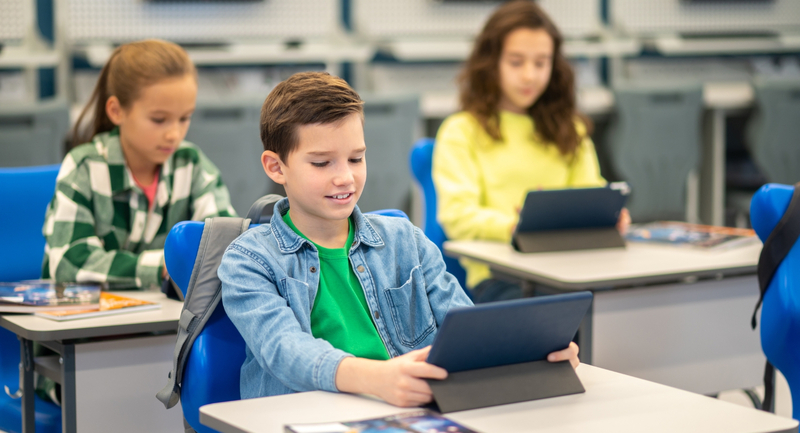
I had been reading the room the way teachers often do. I had thought my lesson on cell organelles was going well. But then I noticed a few of my freshman students were shifting in their seats. One kept blinking hard at the screen. Another had his head down—not asleep, just worn out. I was mentally sorting what I saw into familiar categories: engagement, motivation, stamina, behavior.
Then one student put a hand to their forehead and said, “The lights are giving me a headache.”
That comment made me pause. Maybe this wasn’t about behavior. Maybe I was looking at students trying to learn inside a room that was asking a lot from them before the lesson even began.
The class was working under bright overhead lights, screen glare, wall displays, movement in the hallway, open laptops, browser tabs, digital directions, and the ordinary noise of a school day. Students were not just processing the science content. They were processing the environment around the content.
Since then, I have started asking a different question when students seem distracted: What is competing with their attention?
Engagement Is Not Always the Missing Ingredient
In schools, we talk constantly about engagement. When students drift, the usual response is to add something: more movement, more visuals, more technology, more interaction, more novelty. Sometimes that is exactly the right move. A lively classroom can be a beautiful thing.

Maybe I was looking at students trying to learn inside a room that was asking a lot from them before the lesson even began.
But sometimes the problem is not that students need more stimulation. Sometimes they are already overstimulated.
Cognitive load theory gives educators a helpful way to think about this. In simple terms, students have a limited amount of working memory available for learning. When too much of that capacity is taken up by directions, distractions, clutter, task switching, or confusing digital workflows, less is available for the actual learning task.
Teachers already understand this instinctively. We simplify a slide. We repeat directions. We ask students to close extra tabs. We turn off a row of lights during independent work. We clear the board before a test. These small moves are often treated as classroom-management preferences, but they are also instructional design decisions. They reduce interference so students can think.
Try an Attention Audit
Our physical environment is not neutral. The U.S. Environmental Protection Agency has noted that school design choices—lighting, air temperature, humidity, noise, and indoor air quality—can affect comfort, reduce distractions, and support clearer seeing and hearing. Those conditions may sound basic, but basic conditions become very important when students are trying to read closely, analyze data, solve a problem, or write an explanation.
One practical step toward identifying environmental conditions that may support student attention is to conduct a classroom attention audit. This does not need to be formal, expensive, or evaluative. It can be a five-minute scan before a lesson, during a transition, or after a rough class period.
Ask, What kind of thinking am I asking students to do right now? A lab discussion, a Socratic seminar, a design challenge, a writing task, and a multi-step problem set do not all need the same environment.
Then look around the room from the students’ seats. What are they seeing? What are they hearing? How many open tabs, apps, tools, or directions are they managing? Is the projected screen helping the task or pulling attention away from it? Is the room arranged for the kind of thinking being asked?
The goal is not to remove energy from classrooms. The goal is to make sure the energy serves the learning.
Conducting an audit can also mean watching students for patterns. Are students constantly shifting in their chairs, repeatedly switching through tabs, or losing focus during a transition point? A single student disengaging may reflect any number of individual factors, but when the same behavior appears across several students or consistently among classes, the environment deserves a closer look. The goal is not to diagnose every instance of inattention as an environmental problem, but to ask whether something in the room may be making the cognitive work harder than it needs to be.
Make Five Small Adjustments
If you suspect your classroom environment is hurting, not helping, student engagement, I recommend trying five small adjustments.
- Match the room to the task. If students are doing quiet analysis, dimming one section of lights, lowering visual noise, or removing unnecessary projected material may help. If students are collaborating, the room can handle more movement and talk.
- Reduce digital switching. A lesson that requires students to move between a learning management system, a slide deck, a video, a form, and a shared document may be useful, but each switch has a cost. When possible, put directions, links, and expectations in one place.
- Create short focus windows. I have had more success saying, “For the next eight minutes, we are only looking at the graph and answering question one,” rather than giving a long set of directions and hoping students manage the whole sequence independently.
- Make the invisible visible. Ask students what is making the task hard. Sometimes they will name the content. Sometimes they will name the room, the screen, the noise, the tabs, or the pace. That feedback can guide better decisions.
- Treat environmental adjustment as an equity move. ISTE+ASCD’s Transformational Learning Principles call on educators to reduce barriers to meaningful learning and to design learning experiences that respond to learner variability. For some students, sensory overload, visual clutter, or constant digital switching may be a bigger barrier than adults realize. Reducing those barriers is not lowering expectations. It is making rigorous learning more accessible.
When the Environment Matches the Learning
I am not arguing for silent classrooms, bare walls, or technology-free instruction. Students need conversation, creativity, collaboration, digital tools, and authentic work. The goal is not to remove energy from classrooms. The goal is to make sure the energy serves the learning.
When a lesson asks students to think deeply, the environment should not fight them. A calmer visual field, a simpler digital pathway, fewer competing directions, or a short focused work period can create the conditions students need to engage more fully.
The next time students seem off-task, it may still be a behavior issue. It may still be motivation. It may still require redirection. But before we assume the problem lives entirely inside the student, it is worth looking at the conditions around the student.