

Picture a first-year teacher stepping into his 4th-grade classroom for the first time. He’s spent the last four years working toward his degree and earning his credential. He knows the content. He knows classroom management theory. He knows how to write a lesson plan. He knows how to create a reliable rubric. He may have learned the basics of AI. But what he might not know–what his educator preparation program (EPP) may have missed–is how to teach with AI in innovative, safe, and impactful ways. Further, this new teacher will be one of the most influential adult figures for a classroom full of nine- and ten-year olds. The way he models AI use will shape how his students see the role of AI in their lives.
The shift between learning about AI and learning with AI is real. It is one that EPPs have a remarkable and time-sensitive opportunity to close.
The Shift
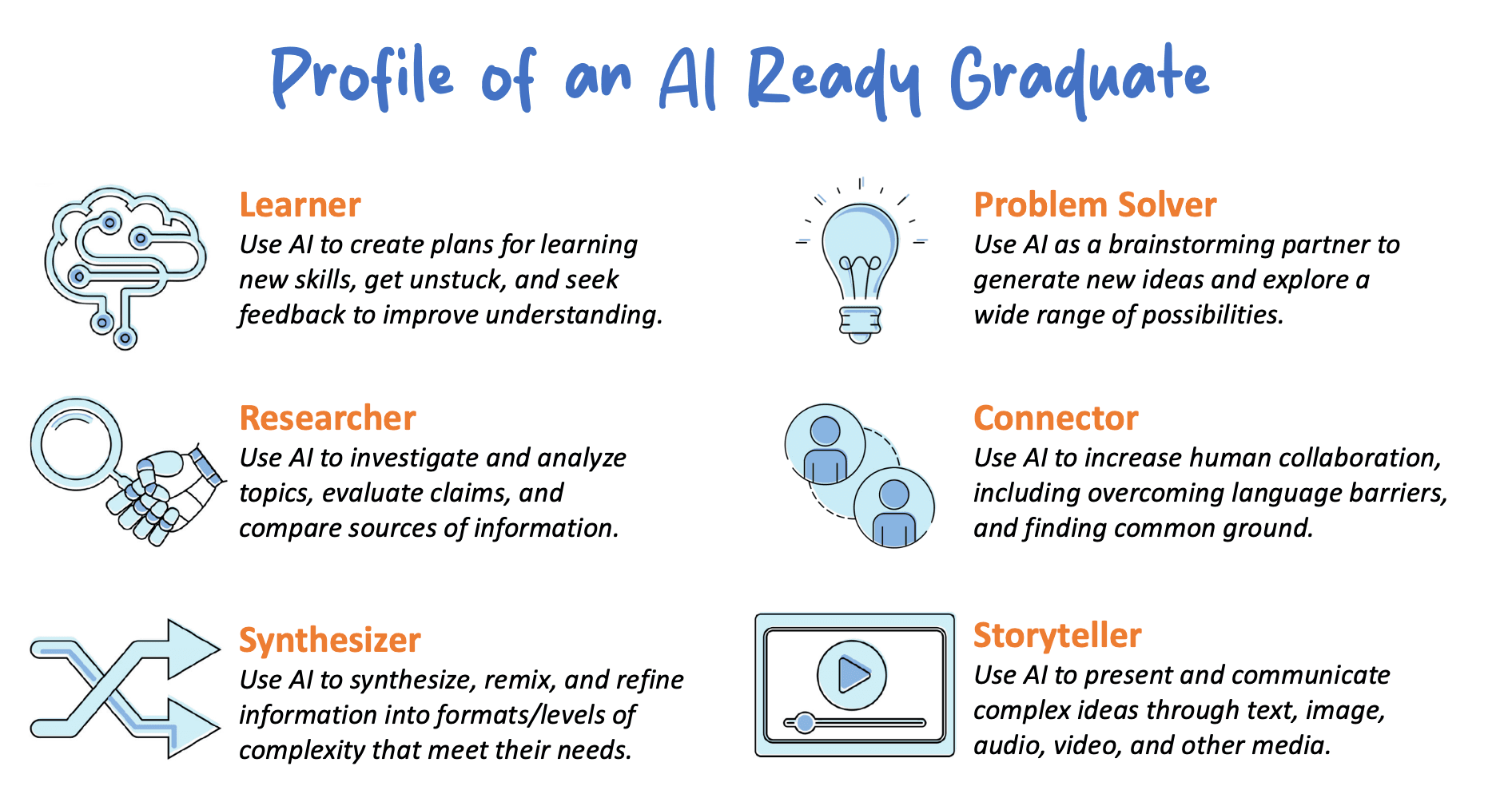
ISTE+ASCD’s Profile of an AI-Ready Graduate draws an important distinction: knowing about AI is not the same as knowing how to work with AI. To thrive in learning and life, the next generation of K-12 students will need to graduate high school knowing how to leverage AI as learners, researchers, synthesizers, problem solvers, connectors, and storytellers. These roles help students learn to use AI to enhance and build on their uniquely human capabilities. Mastering these roles requires much more than having any technical knowledge of AI and how its algorithms work. Mastery means practicing the roles of an AI-Ready Graduate repeatedly, and in meaningful contexts.
The Challenge
It is hard to cultivate the roles in the Profile of an AI-Ready Graduate in students when teachers themselves haven’t practiced the roles. Teacher candidates need to experience what it feels like to use AI to break through a writing block, synthesize conflicting research, or create something they’ve never imagined. More importantly, they need to experience (and practice) when it is irresponsible to delegate a task to AI and when it would be irresponsible to NOT delegate a task to AI. Teacher candidates need to learn (and practice) how to parse out productive struggle (challenges that result in meaningful learning) from unproductive struggle (challenges that do not create meaningful learning). And most importantly, teacher candidates need to develop the pedagogical judgement to know when–and how–to bring their personal knowledge and experiences into their own future classrooms. There are real risks associated with using AI in the classroom, and future teachers need practice making intentional choices about where, how, and why they are using AI.
The Lessons
So where do you start? Four lessons are emerging from EPPs that are already leading the way:
1. Start with the Profile of an AI Ready Graduate and work backward.
Use the Profile of an AI-Ready Graduate as a horizon for your program design. Ask yourself these questions as part of the planning process:
- What does your program do to help future teachers practice being an AI-powered learner, researcher, synthesizer, problem solver, connector, or storyteller before they're expected to facilitate those roles in their own students?
- What guidance, support, and feedback mechanisms are built into their practice?
- How is their mastery of the roles being evaluated? How are they assessing the risks associated with using AI in the classroom?

Teacher candidates need to experience what it feels like to use AI to break through a writing block, synthesize conflicting research, or create something they’ve never imagined.

2. Integrate, don’t isolate.
AI fluency needs to be embedded across methods courses, clinical experiences, and capstone assessments—the same way classroom management, differentiation, and literacy are woven in throughout a strong program. In 2026, AI is integrated into our daily lives. Sometimes we see it clearly, but many times it is so deeply ingrained in our experience that we barely notice it. Teacher preparation programs can aspire to the same levels of AI integration. Teacher candidates should have opportunities across their courses to practice teaching with AI in clear, actionable assignments. At the same time, learning with AI should also be in the background of learning experiences across the curriculum, with opportunities to call out reflections on how AI created a meaningful change in the learning experience.
3. Model the learning you want teachers to create.
Teacher candidates learn to teach the way they were taught—which means the methods courses, clinical experiences, and faculty interactions of their preparation program are the most powerful AI curriculum they'll ever encounter. Teacher preparation programs can take steps to future-ready their programs and curriculum to align with the new normal.
A great place to start is by joining ISTE+ASCD”s Alliance for Innovation in Teacher Education, which brings together 65 educator preparation programs in a shared effort to transform how future teachers are prepared for AI-integrated classrooms. The alliance community is actively creating and sharing models for curriculum modernization that integrate AI meaningful ways to prepare future teachers for the classroom.
To help prepare EPPs to model AI in action for innovative learning, ISTE+ASCD partnered with Microsoft to develop AI for Tomorrow’s Teachers, a five-hour online learning experience designed to build foundational AI literacy, critically explore the risks of AI, and drive practical applications for teaching with AI. Since launching in early 2025, over 5,000 teacher candidates have enrolled in the modules. Impact data from ISTE+ASCD’s post-module survey shows promising results. Eighty-six percent of participants reported that the training helped them grow or improve their skills teaching with AI. Over 72 percent indicated that because of the module, they planned to use AI to design lesson plans and create study support for assignments. Modeling the learning that you want teachers to create has a tremendous impact on the teacher candidate experience. Hear from future educator Aynsley Franklin about how AI for Tomorrow's Teachers is preparing the next generation of teachers to use AI confidently and responsibly in the classroom here.
Modeling learning isn’t always easy. EPPs in the alliance are rapidly innovating approaches to effectively model learning with AI. Specifically, Ball State University Teachers College has adopted an innovative approach for integrating ISTE+ASCD's AI for Tomorrow's Teachers module into their curriculum. Faculty take the module alongside their peers in a community of practice, then engage in facilitated conversations about applying that learning across subject areas—social studies, mathematics, early literacy, and more. The result isn't just individual faculty growth; it's a shared vision, built collectively, for what AI-integrated teacher preparation can look like program-wide.
Programs that build structured AI feedback practices into their coursework and clinical experiences are modeling exactly the kind of iterative, reflective practice that the next generation of teachers will need to bring to their classrooms.
4. Leverage AI to supercharge feedback.
Feedback is a gift, and AI is remarkably generous. Think about three levels where feedback shapes teacher preparation. At the systems level, EPP faculty and deans wrestling with curriculum modernization can use AI as a thought partner to pressure-test program designs, identify gaps in course sequencing, and generate alternative approaches before a single syllabus is revised. At the instructional level, university faculty can use AI to rapidly iterate on course activities, assignment design, and practicum structures—getting volumes of critical feedback on the front end of planning rather than discovering problems after candidates are already in the room. And at the classroom level, teacher candidates can use AI to test their lesson plans, anticipate student misconceptions, and refine their strategies for differentiation before they ever set foot in a K-12 classroom.
The implication for EPPs is significant. Programs that build structured AI feedback practices into their coursework, clinical experiences, and program review processes aren't just saving time, they are modeling exactly the kind of iterative, reflective, improvement-oriented practice that the next generation of teachers will need to bring to their own classrooms.
The Moment
The question isn’t if teacher preparation is keeping pace with AI. It’s if we are willing to reimagine and redesign what is possible in teacher preparation. This isn’t about rushing to adopt every new AI tool or ignoring the risks of AI. It’s about equipping the next generation of teachers with the mindsets, skills, and lived experiences they need to maximize their human potential—with help from AI.
To learn more about ISTE+ASCD’s teacher preparation initiatives, visit the Teacher Preparation web site and watch this short video.
Author's Note: This blog post was created in collaboration with Microsoft.