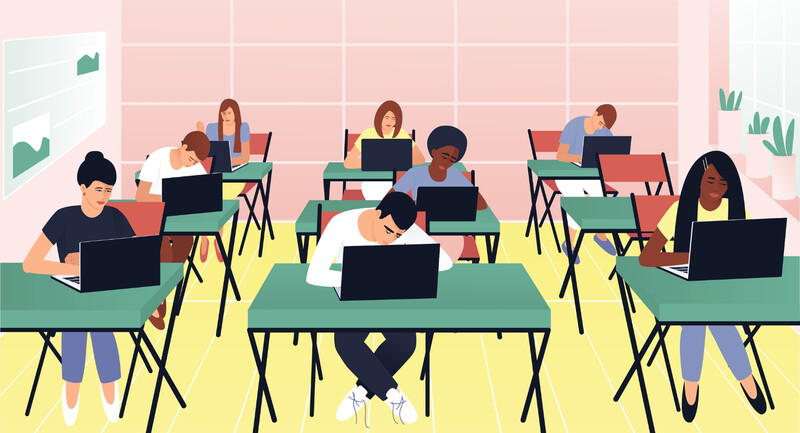
The College Board recently found that 84 percent of students use generative AI to complete school assignments and homework. For educators and parents, this news was so alarming that the Los Angeles Times declared that “homework is facing an existential threat.”
As educators, we know that homework has been on shaky ground for a while. In his Visible Learning books (2009, 2023), John Hattie explained that homework has been shown to have no effect on student performance in elementary school and only a limited effect in middle school and high school. Concerns about homework also come from parents, who often argue that it not only adds to student stress when it competes with after-school activities, but also places inequitable burdens on students who have jobs or caretaking responsibilities.
Despite these concerns, teachers continue to give homework—and for good reasons. First, homework enables students to practice what they learned in class. Second, it can build the valuable skills of time management and meeting deadlines (although Hattie showed that this wasn’t always the case). Finally, it provides teachers with something they really need: information about what each student does and doesn’t yet understand. With this data in hand, teachers can adjust instruction, target misconceptions, and support students more effectively.
Why Students Copy
Of course, all those benefits only materialize if students are doing the work themselves. Fifteen years ago, the Josephson Institute of Ethics found that over 80 percent of high school students admitted to copying another student’s homework. In my organization Crescendo Education Group’s interviews with hundreds of students over the last decade, nearly every student admitted to copying. They copy when they’re short on time due to extracurricular commitments, family tasks, or jobs. They copy when they lack the skills to complete the work and don’t see another viable option. They copy when the homework feels unhelpful or redundant.
Obviously, if the work isn’t the student’s own, there’s a double loss: students miss the learning opportunity, and teachers receive work that masks real gaps and student misconceptions. When students take such shortcuts, it undermines the entire purpose and value of homework.
So why do students copy their homework? Isaiah, a high school student we interviewed, explains: “It’s not, ‘Oh, I want to cheat,’ but it’s just that it’s in my grade. We copy not because we want to be lazy, but because our grade depends on it.”
It may be that the student isn’t completing the homework because of knowledge gaps or circumstances beyond their control—challenges they could choose to share honestly with their teachers by not completing the homework. The problem is, losing homework points means getting a lower grade. So, the student makes a rational risk-mitigation decision: they copy. Even for students who don’t explicitly copy homework, the line between getting “help” from educated parents or tutors and submitting someone else’s work as their own is pretty blurry, and rather than lose homework points, they cross that line.
AI hasn’t changed whether students cheat, only how easily they can do so. To identify students’ use of AI, teachers have enlisted AI detection tools—ironically created by AI. In turn, students have enlisted new AI tools to avoid such detection. This is a battle that teachers can’t win.

When students take shortcuts, it undermines the entire purpose and value of homework.

A Simple Fix
I’d like to propose a better option. As long as homework points count in grades, students are incentivized to take shortcuts. So let’s remove the incentive that drives students to copy. Don’t grade the homework. Teachers can still assign homework, collect it, and give feedback. They may even record the student’s performance in their gradebook. But they should exclude any homework grade from the student’s final grade calculation.
This approach isn’t as radical as you might think. It begins with teachers and students having honest conversations about homework as practice. The free throws a basketball player makes or misses during practice aren’t added to the game score, and the combinations a dancer gets right or wrong during rehearsal aren’t displayed during the recital. What matters is how they approach practice—the risks they take, the adjustments they make based on feedback, their perseverance and diligence. These things determine their performance. This holds for homework as well: homework isn’t the performance—it’s the practice, where there’s no punishment or shaming for mistakes. When teachers stop grading homework, they shift the incentive from the short-term gain of gobbling up daily points to the longer-term rewards of greater learning.
It’s important that students understand that copying homework is like the basketball player who fabricates the number of free throws they supposedly practiced: what the player actually did do—whether they practiced or not—will show up one way or the other in the game, or on the test. By not including homework performance in their gradebook calculation, teachers remove the incentive to copy and comply with the teacher and, instead, put the responsibility for learning where it belongs—on the student. Classrooms become more focused on learning and less focused on jumping through daily hoops.
Homework isn’t the performance—it’s the practice, where there’s no punishment or shaming for mistakes.
How to Make the Shift
Because students have been conditioned by traditional grading to see homework as a point-earning exercise, shifting that mindset begins with rebuilding their understanding of its purpose—how it prepares them for assessments, informs instruction, and reflects real-world expectations. To ease the transition, teachers can reduce homework’s grade weight gradually over a term. They also might share classroom data that show how ungraded practice actually predicts test performance. A simple T-chart can make the correlation between practice and performance visible; one column would indicate the number of homework assignments completed and the other would show the average test score among students who completed that number of assignments.
I understand that teachers may well be asking themselves, “Is this really possible?” After all, teenagers would seem to have shortcuts built into their DNA. If homework isn’t graded, will students even do it? The classroom-based research I noted in Grading for Equity (2023) shows that they will. As Chauncy, a high school science teacher we worked with, noted
It was a difficult change for some students because it’s so different from what they’re used to….Homework completion dipped at first, but then students realized, “If I want a good grade, I need to understand the material.” Homework completion shot up. It’s the opposite of what I feared.
And here’s perhaps the most important point: Freed from the fear of losing points on homework, students are more willing to reveal to the teacher their confusion and obstacles to understanding. Teachers gain valid data about their students’ learning and build more powerful relationships with students through honesty and trust.
If we want to curb students’ shortcuts on homework (and spare ourselves the burden of policing it) while building a classroom culture of trust and student responsibility, we can start by implementing this practice. When homework is no longer about points, it regains its rightful place in the learning process: purposeful practice in service of successful performance. In turn, students develop self-regulation and responsibility. And they learn to engage with AI as a tool for learning—rather than a deceptive shortcut around it.