

Let's peek into a few technology-rich classrooms in which each student has a tablet computer.
- Mr. Svenson's 5th graders use their tablets to read PDF versions of their textbooks. They play drill-and-practice games that reinforce number facts. They write short papers, which they print out and turn in.
- Mrs. Abdo's 11th grade biology students use their tablets to read digital texts that enable them to find definitions of highlighted words and view short videos on scientific concepts. Her unit on natural selection includes a popular game in which students design micro organisms. They place their word-processed lab notes in Mrs. Abdo's online dropbox.
- Dr. Miguel's 2nd graders choose e-books from a large library of online texts, many of which are interactive. A social online math game enables students to interact and collaborate to solve mysteries and earn points. Each of Dr. Miguel's writing assignments starts with students creating a simple mind map using an online graphics tool.
- Ms. Ryuu has replaced her 8th grade social studies textbook with resources in a district-created Moodle course, which she customizes with online readings and activities. Each unit in the course offers reading materials on several levels and a variety of activities that enable Ms. Ryuu to differentiate instruction. On completing tasks that meet state standards, students earn badges that they can display on their personal pages. Students know that most of their writing will be shared with their peers, parents, and the teacher for review and comment using GoogleApps for Education. At least once each semester, students trade papers with peers in a sister school in Japan.
Henry David Thoreau wrote, "It is not enough to be industrious; so are the ants. What are you industrious about?" I think of this quote when I observe technology being used in classrooms. Every teacher in our district uses technology in some capacity, but how they use it ranges from the simple (using an interactive whiteboard to advance a slideshow) to the sophisticated (populating a Moodle course with teacher-created instructional videos that students can watch outside class, thus freeing up class time for guided practice).
Which of these teachers is making the best use of technology? The answer is not as simple as you may think.
Categorizing Technology Use
Several popular tools are available to categorize and evaluate how teachers use technology in instruction. One such tool, the LoTI (Levels of Teaching Innovation) framework, is designed to measure teachers' implementation of the components of digital-age literacy expressed in the National Educational Technology Standards for Teachers. LoTI levels range from non-use to awareness, exploration, infusion, mechanical integration, routine integration, expansion, and refinement.
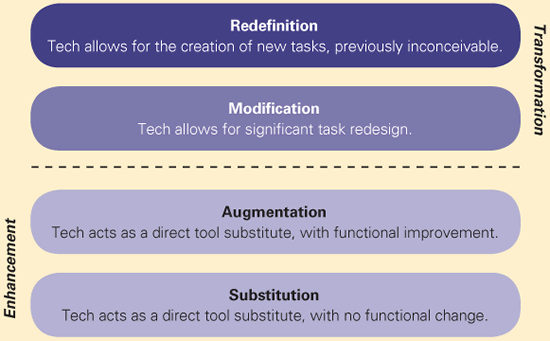
Another example is the SAMR (Substitution, Augmentation, Modification, and Redefinition) model developed by Ruben Puentedura. A geography teacher at the substitution level might have students use an online map to locate a city or country. At the augmentation level, the students would use an interactive online map to analyze a geographic area's combined sociopolitical and physical characteristics. At the modification level, students could use the online map's "directions" feature to plot a trip and justify the best route in terms of travel times and distance. And finally, at the redefinition level, students might create a customized online map of a historical or literary journey with pins that lead to explanations of why specific places are important.
As Figure 1 shows, Puentedura divides these four levels of technology integration into two categories: enhancement and transformation. In other words, is the teacher using technology to basically improve a traditional teaching practice or activity, or is the teacher using it to design activities that could not be done without the technology? The implication is that technology will most powerfully affect student achievement if it is used in the transformation sector—above the dotted line on the diagram.
FIGURE 1. Categories for Teacher Technology Integration
Source: Puentedura, R. R. (2013, January 7). Technology in education: A brief introduction [video]. Retrieved from Ruben R. Puentedura's blog at www.hippasus.com/rrpweblog/archives/000080.html. Used with permission.
Context Matters
Frameworks like SAMR and LoTI are useful for examining technology use. But regardless of the model or terms used, educators need to keep some cautions in mind:
- Different levels of technology use may be appropriate for different learning goals. Education technology proponents work hard to promote the transformational uses of technology (hence the slogan "teaching above the line"). Yet, depending on the instructional objective, technology use that just enhances current practices may sometimes be more appropriate and effective.
- Categorizing technology use is not as clear-cut as it sounds. If a teacher asks students to comment on one another's argumentative papers using a real-time chat window within a word processing program, does it matter whether this use of technology is described as "augmentation" or "modification?" (However, these terms may be good discussion starters to talk about the value of the activity in facilitating peer review of student work.)
- We should assess technology use on the basis of how well students are learning. If the instructional goals of the district are not being met more successfully because of a specific use of technology, who cares how "innovative" that use may be? Transformation for the sake of transformation is a waste of time and energy.
- We also need to look at how teachers are using technology beyond direct instruction for purposes that add value to the educational process—for example, keeping an electronic grade book that is accessible in real time by parents and students, or using data analysis tools to monitor student achievement and provide differentiated learning experiences.
Eyes on the Prize
For many years, the challenge for administrators has been just getting teachers to use technology in the classroom. But the goal has now become getting teachers to integrate technology in powerful ways that increase engagement, require higher-order thinking skills, differentiate instruction, and improve learning.
As education leaders, we like to define, categorize, and evaluate teaching practices, including those that involve technology. It's how we make sense out of our complex environment. Look for good models like SAMR and LoTI that enable you to do that, but keep your eyes on the prize—student learning.
Making It Happen
Be aware of models used to describe levels of technology integration. Be able to employ their terminology when discussing technology use with teachers and with other colleagues.
Evaluate technology use on the basis of how it promotes building and district instructional goals.
Recognize that technology can be used to improve traditional teaching practices as well as to create new means of helping students learn, and that both uses are legitimate. Validate teachers not just for using technology, but rather for using good teaching practices.